

The complete guide to Frontline Workforce Intelligence
Proven frameworks and real-time strategies to help HR and Operations leaders master frontline workforce intelligence—plus, a complete toolkit to accelerate organizational change.

The frontline workforce has changed forever. Today, more than half of the American workforce is “deskless.” They are the backbone of our economy, working in manufacturing plants, distribution centers, retail stores, and transportation hubs.
But these teams are navigating a fundamentally different environment than they were just a few years ago. High turnover, “accidental” managers, and shifting worker expectations have created a talent crisis that traditional HR tools simply weren’t built to solve.
To win in this new era, leaders are moving beyond basic “engagement” and embracing frontline workforce intelligence.
What is frontline workforce intelligence?
Frontline workforce intelligence is the strategic practice of turning real-time employee feedback into actionable insights that drive smarter decisions and stronger operations across frontline organizations.
While traditional employee engagement focuses on broad sentiment scores (how people “feel”), workforce intelligence focuses on actionability. It closes the gap between what workers experience on the floor and what leaders see in the corporate office.
Take action: The frontline workforce intelligence toolkit
Most organizations have an “engagement strategy,” but very few have an intelligence strategy.
To bridge the gap between corporate goals and frontline reality, we’ve developed a suite of actionable resources.
Built specifically for HR and Operations leaders in supply chain, manufacturing, and retail, these tools help you move away from static, once-a-year sentiment data and toward a real-time, action-oriented intelligence model.
1. The frontline intelligence maturity scorecard
Before you can improve, you must know where you stand. This scorecard allows you to objectively audit your current feedback loops and identify exactly where “accidental managers” may be losing the pulse of their teams.
2. The frontline intelligence KPI glossary
Words matter, but metrics drive action. This glossary aligns your leadership team on the high-leverage data that defines frontline success, from early-tenure churn to action rates. We’ve identified the core essentials to get you started, with the flexibility to add the custom metrics that matter most to your specific operation.
3. The frontline communications & change management plan
Alignment is the key to execution. This plan helps you show site managers exactly how workforce intelligence saves them time and reduces daily firefighting. It provides the communication framework needed to help turn frontline feedback into executive-level business cases for safety, productivity, and culture change.
Why these assets?
In a distributed workforce, data is your most reliable bridge. Use these tools to stop simply measuring how your workforce feels and start mastering the intelligence that moves your business forward.
Frontline intelligence vs. traditional engagement
Engagement is often tactical—measuring how people feel once a year. Intelligence is strategic—understanding why things are happening right now to help predict what will happen next.
Why HR and operations need it now
The standard tools built for office workers fail on the frontline because they ignore the unique pressures of the floor: shift scheduling, physical demands, and high turnover cycles.
1. The post-pandemic talent reset
Many frontline teams expanded rapidly to meet demand, often faster than leadership could keep up. Early-tenure churn remains high, with a significant percentage of turnover occurring within the first 90 days. Without real-time visibility, you are reacting to exits instead of preventing them.
2. Accidental managers and leadership strain
In frontline environments, high performers operators are frequently promoted into leadership. But being great on the production line doesn’t automatically mean you’re an effective people leader. Frontline intelligence gives these managers clarity on where to focus, transforming them from reactive problem-solvers into data-informed coaches.
3. A new generation with new expectations
Younger workers want frequent feedback and two-way communication. Traditional annual surveys were designed for people with desks and company emails—not for shift-based workers who need tools that meet them where they are.
Featured expert: Building culture across the frontline
“Culture doesn’t travel evenly.” — Katherine Celli, People Strategy & Transformation Expert
In a decentralized workforce—across multiple plants, warehouses, or retail hubs—culture isn’t what is written in the corporate handbook. It is the lived experience of the employee on the floor.
In our interview with Katherine Celli, she breaks down why traditional top-down communication fails the frontline and how to empower the “culture carriers”: your frontline supervisors.
Key takeaways from Katherine:
- The supervisor effect: Your frontline managers are the primary drivers of culture. They need clarity, capability, and real-time support to lead effectively.
- Systems thinking: Processes fail when people don’t feel valued. Success requires bridging technical operations with human-centered leadership.
- Proactive listening: To maintain trust during uncertainty, leaders must move beyond memos and embrace transparent, two-way communication.
TOOLKIT
The complete guide to Frontline Workforce Intelligence
Access our three-part toolkit to accelerate your transition from traditional engagement to frontline intelligence. These resources help you audit your maturity, master the metrics that matter, and align your site leaders—providing everything you need to build a strategy as unique as your workforce.
What frontline workforce intelligence unlocks
When you treat workforce intelligence as a core business capability, you unlock three major operational advantages:
- Turnover prevention: Identify risk in the critical first 90 days and intervene before a worker decides to leave.
- Operational visibility: Surface equipment issues and safety hazards in real time before they disrupt production.
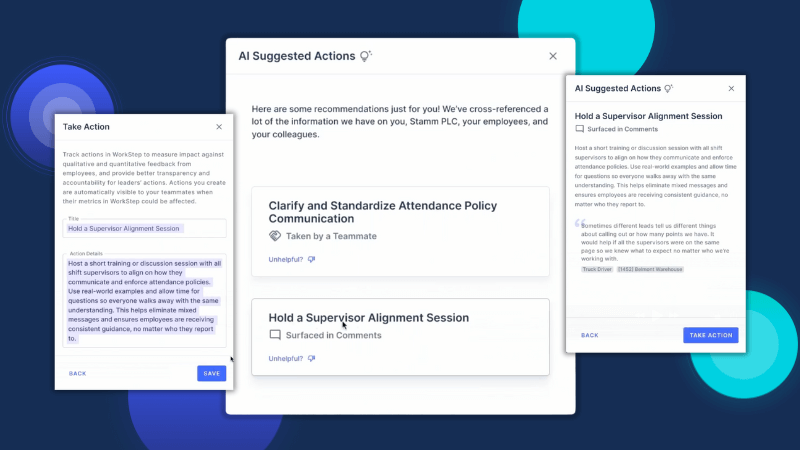
- Leadership empowerment: Equip site managers with targeted action and AI-powered tools that help them build trust without adding hours to their administrative workload.
Featured expert: Mitigating risk through frontline visibility
“They’re the ones most impacted by disruptions, and they often have the smartest, most practical solutions.” — Jeff Schellinger, Supply Chain & Operations Leader
In the high-stakes world of supply chain and manufacturing, risk management used to be a “checkbox” exercise. But post-pandemic reality has proven that traditional models fall short because they lack real-time visibility into the floor.
Supply chain expert Jeff Schellinger argues that your frontline employees are your most important risk sensors. By building a “resilience culture” powered by workforce intelligence, organizations can spot material shortages, safety hazards, and labor shifts long before they hit the bottom line.
Key takeaways from Jeff:
- The “sensing and reacting” loop: Resilience isn’t a static plan; it’s a constant feedback loop. Leaders must gather real-time data from the ground to adjust strategies on the fly.
- Frontline leaders as first responders: Your site managers are the ones who execute your playbooks. If they aren’t empowered with frontline intelligence, your risk mitigation strategy is just paper.
- Inclusive problem-solving: Moving from top-down mandates to inclusive engagement taps into a wealth of practical knowledge that corporate offices often miss.
How WorkStep powers frontline intelligence
WorkStep is the only platform built specifically to bridge the gap between employee feedback and business outcomes. We don’t just flag issues; we help fix them through a four-pillar approach:
- Listen: Automated, 60-second milestone-based surveys that meet workers on their terms.
- Communication: Two-way, confidential channels that close the loop between leadership and the frontline.
- Predictive insights: AI that identifies which teams are at risk of turnover before it happens.
- Action: Real-time coaching and AI-generated replies that help busy managers respond to feedback instantly and effectively.
Expanded resource library
To go deeper into how workforce intelligence transforms specific areas of your business, explore our “Action over Awareness” collection:
- Stop chasing the wrong engagement metrics: Engagement isn’t a number on a dashboard. It’s a living, breathing relationship with your workforce.
- Less action planning, more action: How to move away from 6-month “improvement plans” toward real-time resolution.
- The problem with benchmarking: Why traditional benchmarking often distracts leaders from the unique root causes of their own turnover.
- Unlock smarter workforce insights: A look at how AI-powered Comment Insights automatically analyzes every open-text comment in your scope over the past 90 days—so you don’t have to.
- Empowering leadership action with AI Replies: How to help support leaders in responding to employee feedback with greater confidence, empathy, and speed.
Accelerate your frontline workforce


Download the frontline workforce intelligence toolkit
Download the workbook to quickly get access to practical exercises to build your comprehensive frontline employee engagement strategy.